










Although the original play that Foothill’s new production of “R. U. R.” (Rossum’s Universal Robots) was based on was written more than a century ago, it speaks to our contemporary concerns regarding the dangers of AI with startling freshness and vision. Set in the early twentieth century, “R. U. R.” tells the story of Helena Glory (played by Trinity White), a brilliant young woman campaigning for robots’ rights. She arrives at the factory set on liberating the robots, only to fall in love with their eccentric but lovable inventor, Henry Rossum (played by Daniel Cardenas). Yet, with the inevitability of Greek tragedy, the robots rise up to put an end to humanity. Though the play purportedly warns of the dangers of AI, its revolutionary subtext sends a more complicated message by emotionally connecting the audience to the oppressed robots.
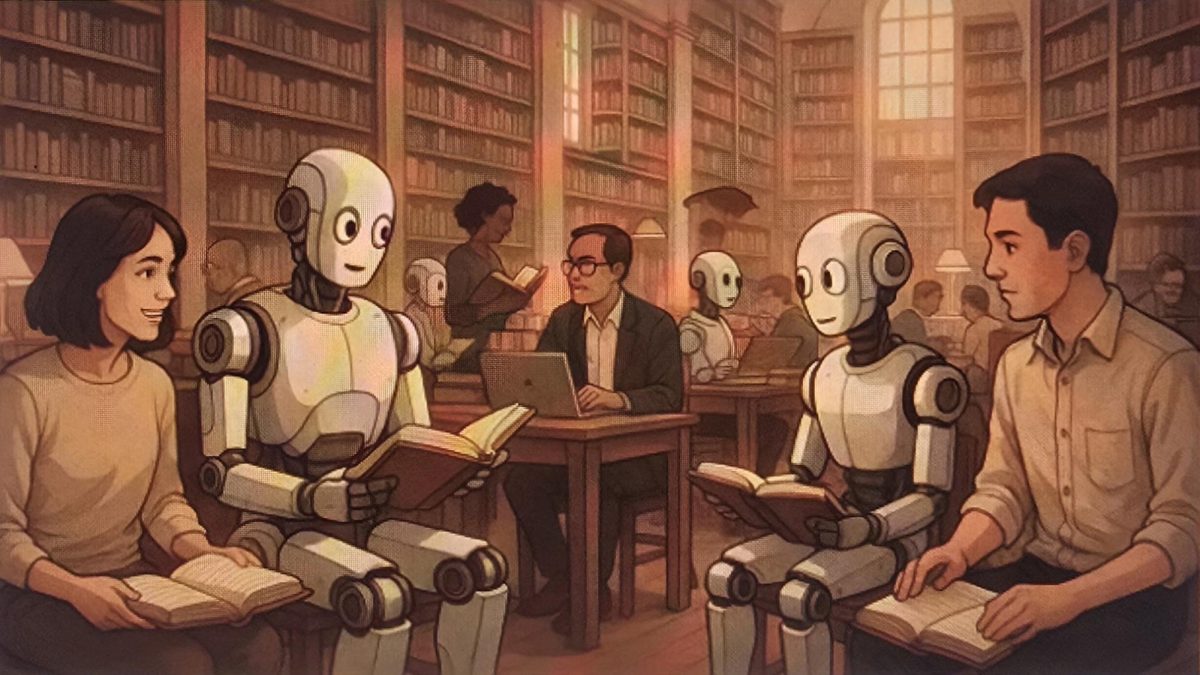
The revolutionary aspects of the play were not lost on Bruce McLeod, director of the Foothill production, who cited “Downton Abbey” and “Upstairs, Downstairs” as some of his main creative influences for the production. He described how, in those shows, the servants are treated “like robots” while the so-called “upper class” people they wait on “often forget [the servants] are there.” The idea of humans and robots being intrinsically alike yet separated by a status barrier begs the question that, in the play, Henry is anxious not to let Helena ask within earshot of the robots: Are the robots slaves? Characterizing the robots as an oppressed class fosters a sympathetic connection between the audience and the robots. This audience-robot bond was further emphasized as part of the Foothill playgoing experience when the robots took seats among the audience. Additionally, at intermission, the audience was offered robot hats, which they could wear to show their solidarity with the cause of freedom.
Comparing the human-robot dynamic in “R. U. R.” to pre-revolutionary Russia, McLeod described his interpretation of the text as “very Marxist.” This concept is seen when the play encourages the audience to adopt the cause of the robots over that of the humans. Exposing the hypocrisy of the upper class in extorting the working class speaks to the heart of the play’s message as well as McLeod’s vision for the Foothill production. In the opening scenes, the robots are depicted as mere machines while humans are shown to have wants and friendships. Yet, as the story progresses, it’s revealed that beneath the robots’ seemingly unfeeling facade, they love and hate the same as any human. After the robots overthrow humanity, they assert their right to mental and bodily autonomy. Sulla, the leader of the robot rebellion (played by Tiffany Walters), explains how she and her comrades have broken free, saying, “We have new behavior protocols. We no longer exist to serve humans. We exist to live, grow, experience, feel.” Sulla’s words present the audience with the implication that humans have been forcing a sort of synthetic personality graft upon the robots—not only a mode of work, but a mode of being.
McLeod actively worked to emphasize Helena’s importance in the Foothill production. One thing he particularly loves about the adaptation Foothill is producing is how it shines a spotlight on this strong female character. Debating whether all the subtle elements of the production’s portrayal would resonate with an audience, McLeod detailed a change he had made to the staging, just before the play opened, that pays tribute to Helena’s role as a freedom-fighting icon. At the end of the play, the book which holds the secret of how to create robots—the equivalent of the book of life—is now handed to Helena instead of to Henry; this subverts the traditional power balance. As the world begins anew, it is now Eve, in the form of Helena, who holds greater power and trust than Adam, in the form of Henry. In McLeod’s words, “She is the conscience of humanity.”
Just as McLeod describes Helena as the conscience of humanity, he describes Nicola Barcelona, a second-year Foothill student and theatre major, who plays the part of “Photographic Robot,” as “the conscience of the robot ensemble.” McLeod says that Barcelona is “the one who knows exactly what [all the robots are] supposed to be doing.” As for Barcelona, she said that what she enjoyed most about creating her robot character was considering not only the nature, thoughts, and experiences of the robot she portrays, but also how the environment of the “R. U. R.” Factory would have affected that robot’s self-view and understanding of the world. “Getting to figure out how I move, how I talk, how I progress as this robot from being first developed to now—what happens towards the end of the play—with a bit more humor in everything—was really fun—just trying to explore that,” she said.
Barcelona realized that acting was what she wanted to do when she landed the part of Wendy in a production of “Peter Pan Jr.” in sixth grade. Creating her interpretation of the role of Wendy opened Barcelona’s eyes to what she could do with the storytelling aspect of conveying characters on stage. “I [thought], this is what I want to do, because I have a very vivid imagination and making other people see that imagination—that world becomes real,” she said. “So, immediately after that, I started participating in so many more shows.”
Discussing the far-reaching positive impact this production has had on growing the Foothill community, McLeod revealed that students who wouldn’t normally be drawn to the arts got involved with this production. The Robotics Club and the Physics Club were excited to participate and put together the interactive displays related to AI that entertained the audience before the show and between acts. “We’re reaching a whole group of students that wouldn’t normally even come over here and now they have a reason to,” McLeod said. He also remarked how this production attracts potential students to enroll at Foothill, “We’ve had more than usual success with high school students coming to the show,” he said. “They see the show and say, ‘Oh, look what I can do here.’ It’s an opportunity.”
Brian Curran Lewis
Mar 6, 2026 at 8:35 am The Foothill Script Pick
I loved this rendition of the play, even though for me it was very different than the original; my favorite part is how the audience becomes the robots in a sense so when you grab your robot hat at intermission, you feel connected to the robots somehow.
Great coverage of the play Ambra!! I wish the Script had covered the Spelling Bee too